|
Alex's Journey to the Grave
» Visual Novel | Emotional | Reflective | Mature Themes
Sasha here! 👋
Here's a snippet of the overview from the press kit:
|
|
|
|
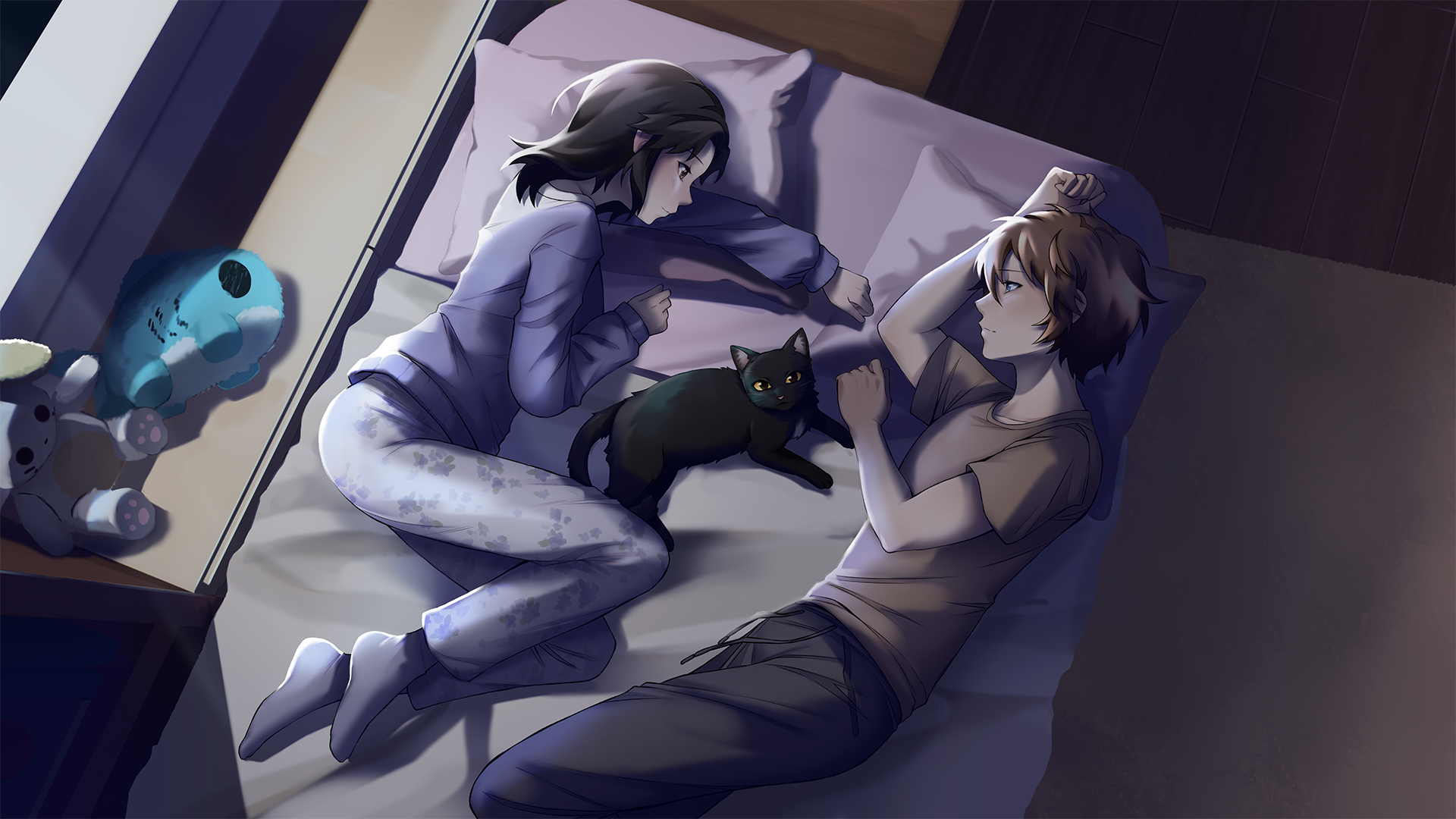
Alex’s Journey to the Grave (or AJG for short) is a visual novel about a boy trapped by fate and a girl in dire need of a friend. The player will guide them through some of the hardest decisions of their lives as they experience warmth, connection, tragedy, the inevitability of death… and the antics of a mysterious black cat.
|
|
|
|
|
One evening, I booted up the game and opened my note-taking app of choice. I had every intention of writing down meaningful thoughts as I played. That did not happen. I played through the whole demo without thinking of anything else. I was intrigued by the story. I felt close to the characters.
I personally haven't had many experiences like that with a visual novel; I don't typically enjoy reading for long periods of time. Yet, at the end of the demo I wanted to know more.
The game's writing took me on a rollercoaster ride of emotions. It started by introducing the protagonists feelings of self-deprecation, then somehow made me feel giddy about the two characters’ interest in each other, only to be reminded of the intense self-loathing of the protagonist. The writing and auditory queues puts you in the mind of the protagonist in more than just a literary way; the emotional shifts and moments of distraction in the text felt almost like a magician’s sleight of hand, skillfully directing my attention. I didn’t feel misled by this misdirection, instead it helped me understand the protagonist on a deeper level. The experience brought me closer to the character.
|
|
|
|
The Interview
Duhop, the main creative behind Alex's Journey to the Grave was kind enough to answer a few questions about the game for us.
|
|
|
|
What is Alex's Journey to the Grave?
|
|
|
|
"Alex's Journey to the Grave is an emotionally immersive experience that places you directly inside the minds of two troubled young adults in modern North America, and takes you through a rollercoaster of emotions as their fates are irreversibly intwined.
Leaving the rest of the actual story overview to the press kit linked above, I'd describe the game as a sort of commentary on the mental health and emotions of young people today. It takes the player through not only the most painful depths of despair—the worst of the struggles that so many young people experience, yet are so often hidden from view—but also through the peaks of love and happiness that can so starkly contrast them.
It's a story meant for those who love to feel emotional, among those who have a desire to feel seen and those who'd like to learn how to see them."
|
|
|
|
|
Who would you recommend this game to and why?
|
|
|
|
"There are two very different groups of people who seem to have found something special in Alex's Journey to the Grave so far.
The first are those who relate heavily to the characters in the game, and have had dark experiences similar to those of the main characters before. This is the audience that the game was originally conceived for, and they've thankfully had great things to say about it so far.
The second, generally older/parental audience, are those who have not had similar experiences before, but want to understand them. I never expected it, but several times now I've been given the exact same feedback; apparently, for this crowd, Alex's Journey to the Grave is like a window into the minds of those who have. A way for them to understand such struggles and emotions in a way they never could before, and an emotional experience in itself that stirs an incredible sense of empathy for a previously unfamiliar perspective.
I've also heard from the first group that there are people from the second group who they wish would play the game as well, because they also came to the same conclusion that it would be a good way to help those people in their lives understand and empathize with them better. The most common examples are parents, teachers, and—disappointingly enough—mental health professionals.
In the end though, you don't need to belong to either of the above groups to enjoy Alex's Journey to the Grave. If you're a person that enjoys emotional experiences of any kind (basically, media that makes you cry), then it's probably for you."
|
|
|
|
|
The final game will have 6 acts. The demo is just the first act and is a linear experience. In the next acts will there be mechanics that make the experience more interactive?
|
|
|
|
"Yes. Following Act 1, the remaining acts will all have choices that alter and impact the narrative in a meaningful way, although the story itself will stay mostly linear until branching out toward different endings in the later acts. The endings themselves will also be influenced by your choices throughout the game.
There will of course be some significant replayability after finishing the game the first time, including some secrets that I won't reveal here ;)"
|
|
|
|
|
The game features some pretty heavy themes. What's something you want people to walk away with after playing this game?
|
|
|
|
"I have put an incredible amount of thought into this.
What I think makes Alex's Journey to the Grave unique is a choice not to censor anything in this regard. I deliberately show and exemplify the darkest of the main characters' darkest moments, in unusually graphic detail.
I want it to feel like the story is reality—that the pain and discomfort is inescapable—in the very same way it feels for the characters. I don't want it to feel like there is some mysterious author, or social/corporate politics, or any other third party curating/watering down the experience. I don't want the darkest, most critically intense moments to be simply alluded to, then copped out of with a timely fade to black.
Why? Because I think it's important.
I think it's important for people to see and experience these things that so many are so scared to portray, address, or talk about directly. I think it's important for those who can relate to feel wholly seen for once; to understand that they truly aren't alone in their reality, and to realize it's possible to fall to the darkest depths imaginable, yet still overcome them anyway.
I also think it's important for those who can't relate to see exactly what has been so consistently hidden from them; to learn exactly what it's like to have these experiences that society has swept under the rug so deliberately, and to gain empathy for struggles they might not have the perspective to understand otherwise.
I want parents to understand the struggles of their children, teachers the struggles of their students, and professionals the perspective of their patients. I want sons, daughters, and pupils to feel comfortable opening up about their issues, knowing that they will be taken seriously; that they won't be at risk of having their freedom stripped away from them, or being forced to endure inhumane "treatment" at the hands of someone who doesn't even have a clue what they're going through.
Unfortunately, there is a portion of the game's potential audience that are sensitive to such graphic depictions, and would be better off avoiding them. Since the game does have a content warning, I never planned to do much more than that to address the issue.
However, much to my surprise, a certain feline appears to have taken things into her own paws recently... and honestly, I'm pretty satisfied with her new solution to directly ask the player to make a choice about censorship. It's a new direction that I believe will help the game become a lot more inclusive, without sacrificing one of the main things that makes it so unique and important to me."
|
|
|
|
|
I'm curious about the character's names being the same. Is this to purposfully ambiguate the title of the game or is there another reason behind it?
|
|
|
|
"Ambiguate is a funny word. I might just ambiguate this answer, if you aren't careful."
|
|
|
|
|
The game's story features a cat. I'm wondering what sort of connection you have with cats? Is there a cat that helped inspire this game?
|
|
|
|
"I love cats, and I think they are by far the best animal to take up the very necessary role of the cat in the game. In fact, I'd say the role is built more from the inspiration I get from cats than the other way around. The cat is so utterly necessary to the story, and has been such an important part of it from the very beginning, that I do believe such feline creatures are entirely critical to the game's very existence.
I adore the wistful, smug, and aloof personalities that many cats have, especially when they turn on a dime to contrast it with their loving and needy sides. That alone makes them incredibly interesting to me as a writer; it just feels so easy to shape them into an interesting, mysterious character, and—for this story specifically—to turn their love into a worrisome empathy with nothing but a dash of intelligence.
The cat's specific personality is partly inspired by my own cat Cleo pictured below, and partly by a person I used to know a long time ago. Her physical appearance is inspired by a random kitten I saw in a pet store once, also pictured below (he blurry)."
|
|
|
|
|
Closing Thoughts
Not every Friday will be an interview format but my intent is to focus on games that you might want to sit down and spend a Friday or two playing. I would say Alex's Journey to the Grave is one of those games.
You can tell that Duhop has put some considerable amount of thought into the production of this game. If anything you read above resonates with you I would encourage you to check it out for yourself.
Grab a snack, a cup of tea, and play the demo.
It's about 90 minutes long.
|
|
|
|
|